I’ve been a huge Kindle reader for over a decade. I remember getting my first Kindle when I was still in school, finding an online tutorial to “root” it, and then using that newfound access to copy my own wallpapers onto it — replacing the old black and white printing press/woodcut images you may remember. I also had lots of fun with Calibre, finding DRM-free books on internet sites which I won’t name, and loading up all of my textbooks as PDFs.
My newest Kindle (a Paperwhite, gifted to me by an ex-girlfriend) isn’t used as much. The issue is that the Kindle app is now the more convenient option. It’s probably one of the most used apps on my phone. The benefit of having most of my reading take place on one platform is that I can track my reading history without needing Goodreads or something like that. Figuring out how to export it took me a while, but now it’s done — let’s take a look.
The library
According to my Kindle library data, I’ve got close to 400 books on there. There’s a huge range — a lot of fantasy (there are 41 Discworld books alone), sci-fi (Herbert, Asimov, and Banks feature heavily), and a huge range of non-fiction (Nassim Taleb and Michael Lewis appear the most).
I won’t paste the full 400 here, but here are some fun insights.
By the numbers
- 409 books across 109 different authors
- 85% fiction, 11% non-fiction, 4% other
- Longest series commitment: Discworld at 39 books, followed by Dresden Files (19) and the combined Malazan universe (18)
- Most-read author (number of books): Terry Pratchett, and it’s not even close
Top authors
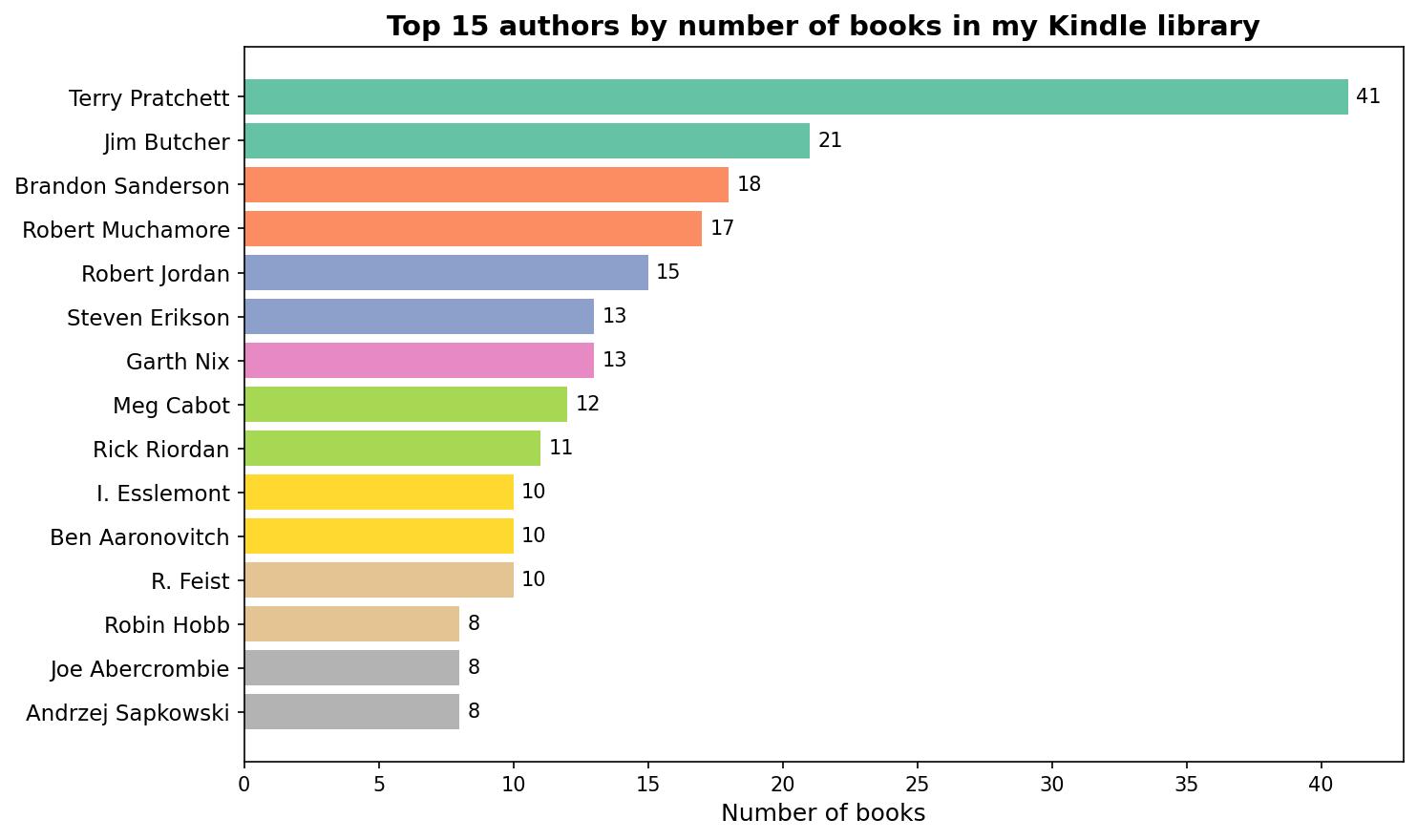
Terry Pratchett dominates with the full Discworld run plus Good Omens. After that it’s Jim Butcher (the entire Dresden Files), Brandon Sanderson (Cosmere completionist), and Robert Jordan (all 14 Wheel of Time books plus the prequel). The Malazan universe — split between Steven Erikson and Ian C. Esslemont — adds up to 23 books between them.
Now, this number isn’t perfectly accurate. On Kindle, it’s often cheaper to buy an omnibus, and this counts as one book. Feist’s Riftwar series is actually 30+ books, but they’re all sets of trilogies, which is why I only have 10 or so.
But what about page count?
Number of books is a misleading metric. A Discworld novel is around 350 pages. A Malazan entry is closer to 950. Measuring by estimated pages reshuffles the rankings entirely. NB — estimated pages were used as I didn’t want to get the full data for all 400 entries. This also means the omnibuses may be underrepresented. However this doesn’t look awful to me. I would have expected to see Stephen King’s Dark Tower series here, as those are 7 pretty well-sized books, but maybe that’s still not enough to make the top 15.
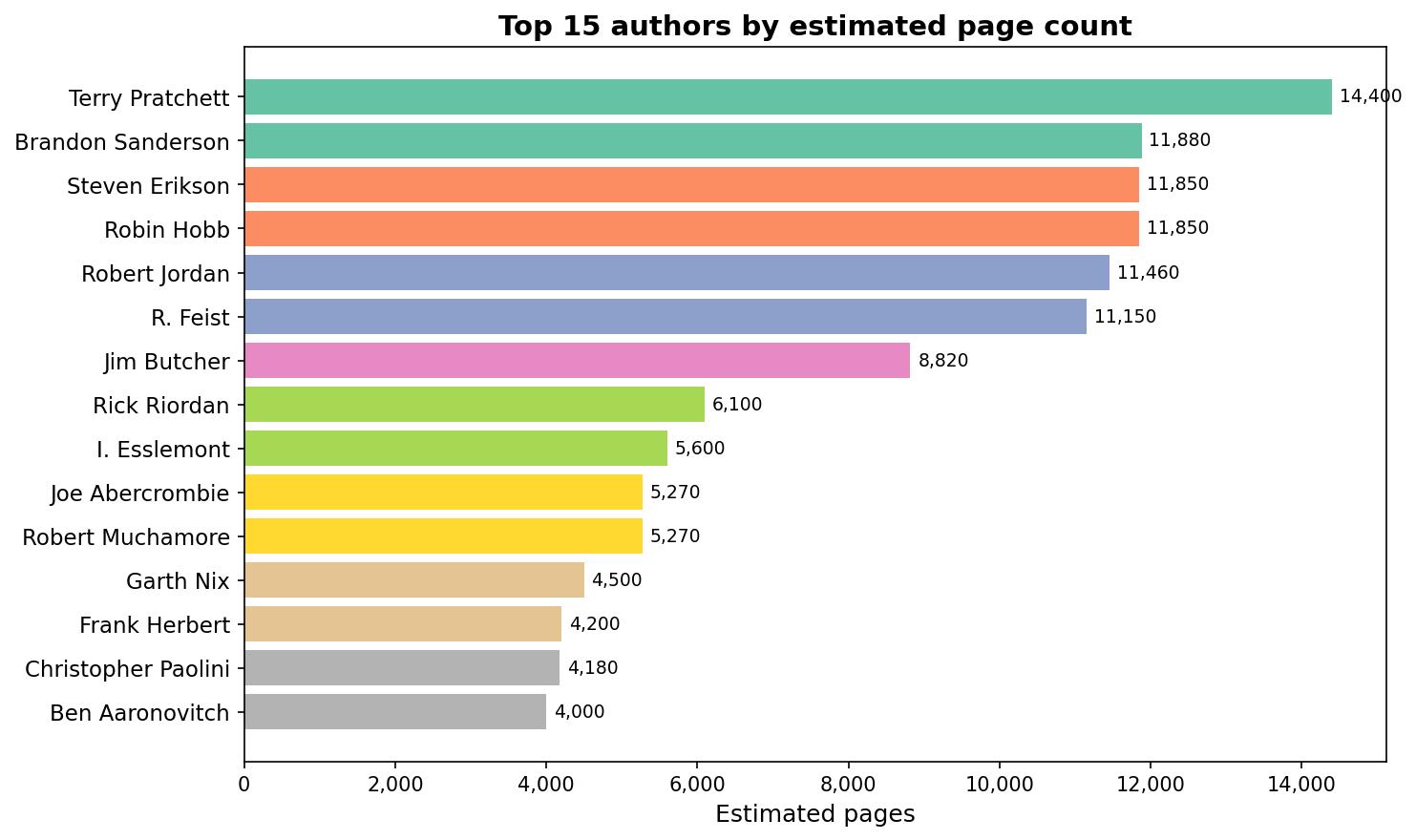
Terry Pratchett still leads — 41 books at ~350 pages each adds up to over 14,000 pages. But the gap closes. Brandon Sanderson, Steven Erikson, and Robin Hobb all push past 11,000 pages thanks to their brick-sized entries. Robert Jordan’s Wheel of Time — averaging nearly 800 pages per book — lands at 11,460 pages from just 15 books.
The real story is in how the rankings shift:
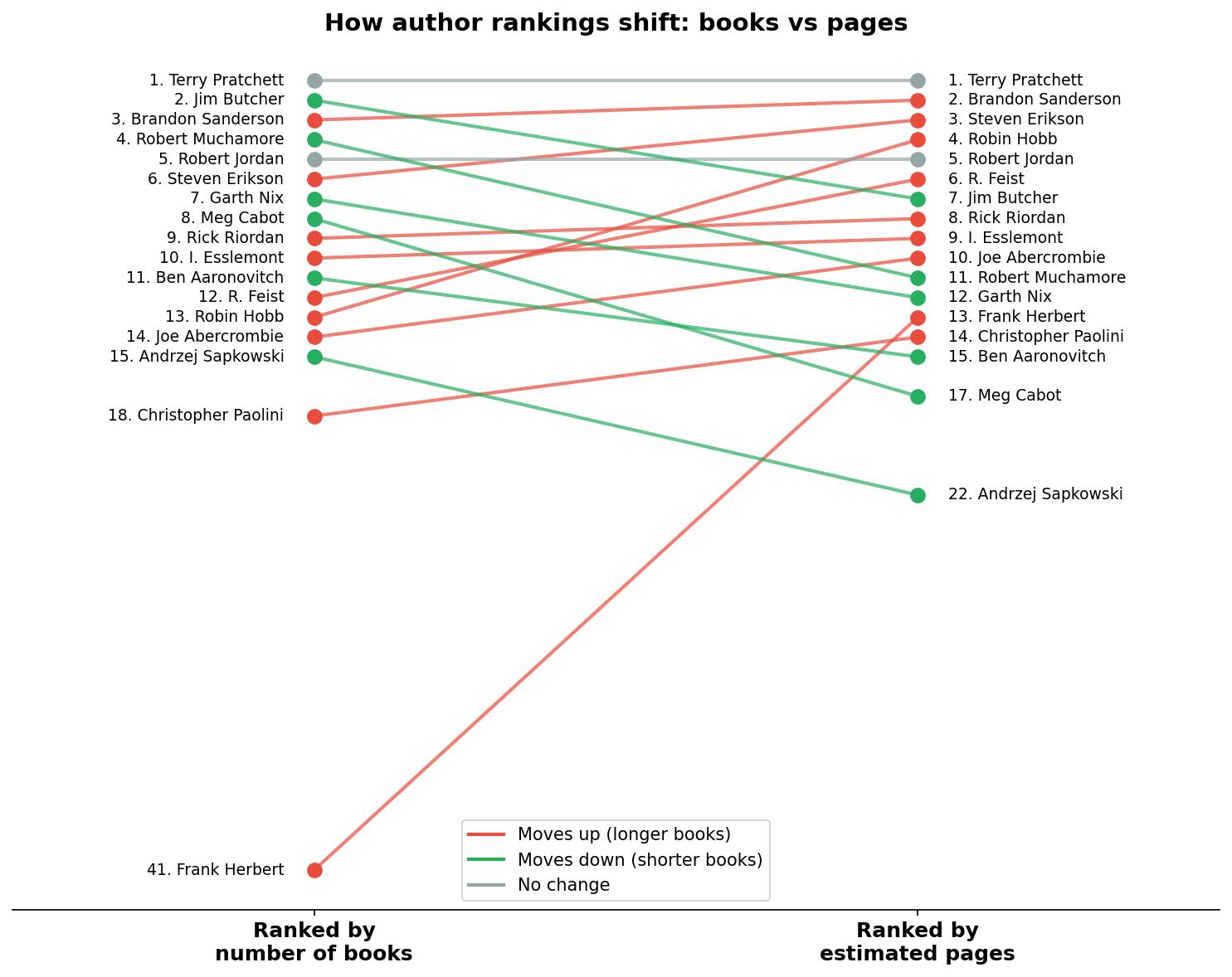
The biggest movers:
- Frank Herbert jumps from #41 to #13 — only two entries in the library, but the Dune trilogies are enormous
- Robin Hobb climbs from #13 to #4 — those Liveship Traders and Farseer omnibuses are monsters
- Meg Cabot drops from #8 to #17 — the Princess Diaries books are ~300 pages each
- Robert Muchamore falls from #4 to #11 — CHERUB books are fun but short
In total, that’s roughly 200,000 pages — or about 500 pages per book on average.
Genre breakdown
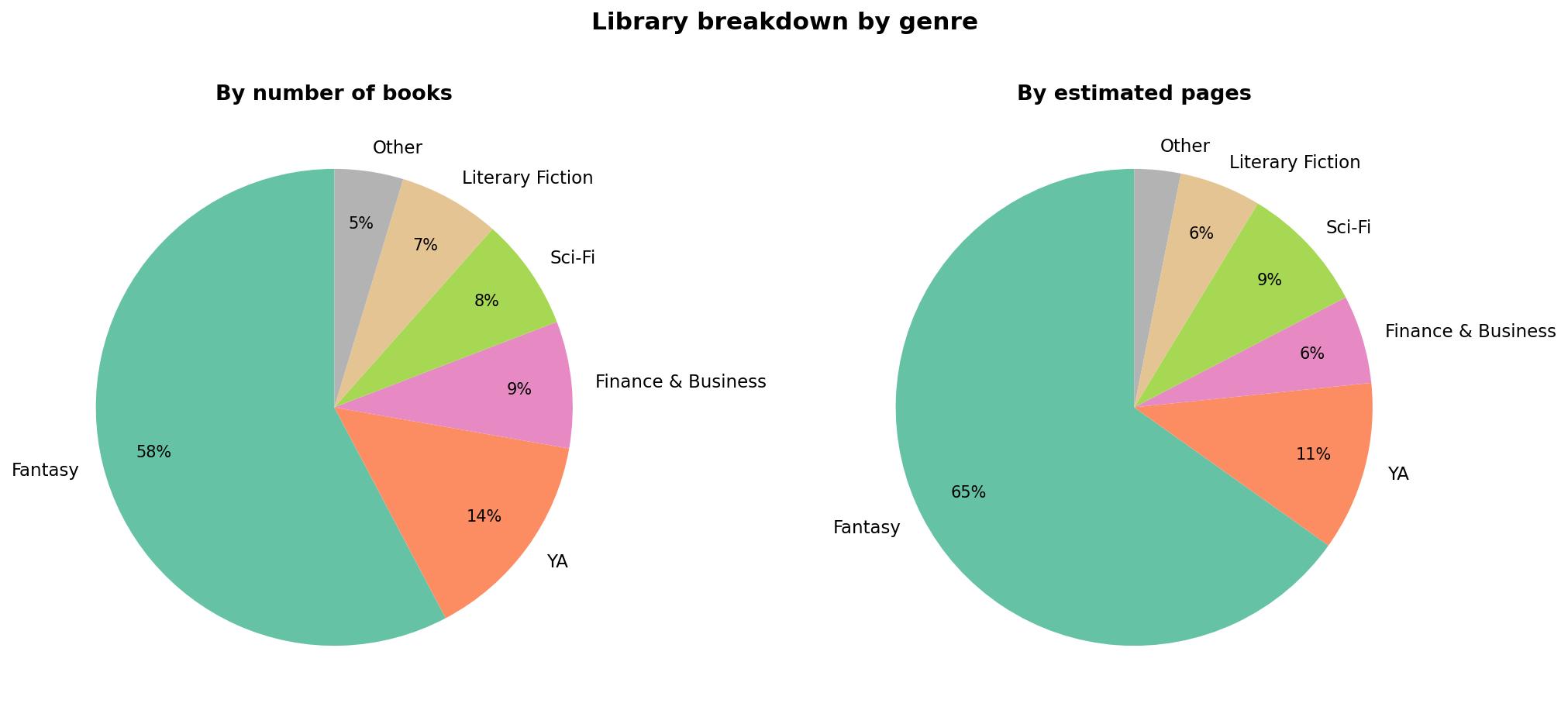
Fantasy takes the lion’s share either way you measure it — but it’s even more dominant by page count (65%) than by number of books (58%), because fantasy authors write long. The non-fiction skews heavily towards finance and business — Michael Lewis alone accounts for 8 books, and the Taleb Incerto series is all five. The YA section is a nostalgia trip: CHERUB, Artemis Fowl, Percy Jackson, and the Princess Diaries all made it onto the Kindle. YA and Finance both shrink when measured by pages — short books, relatively speaking.
Fantasy and sci-fi winners
Anyone who knows me knows that the Wheel of Time is my favourite fantasy series. My most valuable object is a signed copy of The Shadow Rising (the fourth and my favourite book), which I saw in the high-end section of Powell’s Books in Portland. But if I had to rank the fantasy on my Kindle library (not the fantasy I’ve read, as I have paperbacks for Lord of the Rings, Game of Thrones, and a few others), the top 3 would be:
- The Wheel of Time — essential, era-defining, Mat Cauthon is one of my favourite characters in fiction. I’ll be forever annoyed at Amazon/Rafe Judkins for butchering the show.
- Malazan — epic and ambitious, but quality drops outside of the main series. The Kharkanas books were not fun for me to read.
- The Stormlight Archive — Brando Sando will leave his mark on fantasy writing for sure. His Cosmere, often described as the MCU of fantasy, is staggeringly vast. Stormlight is the centrepiece. The Way of Kings and Words of Radiance (Stormlight 1 and 2) are incredible entries and standalone books. The quality gets slightly weaker as we go, but Stormlight 5 is still a very strong book and I’m excited to get the next half of the series (potentially before I turn 40).
Low performer: Not who you think of when you hear fantasy, but I tried Rushdie’s Midnight’s Children and just couldn’t get into it.
Honourable mention: Feist and Janny Wurts’ Empire Trilogy (arguably part of the Riftwar, but pretty standalone) is one of the top “self-contained” fantasy trilogies ever. Mara of the Acoma is a great heroine — also one of the few female protagonists here, but by far the best.
It’s harder for me to make a similar list for science fiction. Firstly — I love Foundation. Hari Seldon, with his psychohistory, made me want to get into stats and probabilities and is arguably the “first” data scientist in fiction. That Salvor Hardin quote — “violence is the last refuge of the incompetent” — is still an all-time favourite. The only reason Asimov doesn’t stomp his way to number 1 is Frank Herbert and Dune. Dune is to science fiction what Lord of the Rings is to fantasy.
I’ve also read a lot more modern stuff — Adrian Tchaikovsky’s Children series is genuinely thought-provoking (and made me dislike spiders less), and Cixin Liu’s Remembrance of Earth’s Past trilogy is epic in scale, covering the birth and death of new universes by the end of it. Dark forest theory, Luo Ji’s mutually assured destruction, and the vector-foil fate of the solar system are all ideas that sit with you long after you’ve finished it. But then you’ve also got things like Project Hail Mary, which becomes a sci-fi buddy cop romp. I’m still working my way through the Culture series, so let’s see if that makes the cut.
Non-fiction
I do have a soft spot for Wall Street history, and all things finance generally. When it comes to Wall Street history, the classics are:
- Barbarians at the Gate (about the PE buyout of RJR Nabisco). If I remember correctly KKR were involved here, and it was one of their analysts who voted to do the deal, as the partners were on the fence
- When Genius Failed (RIP LTCM)
- Liar’s Poker (which sparked Michael Lewis’s success, leading to some of my favourite movies being made too)
Taleb’s The Black Swan and Fooled by Randomness are also both great books. I tried Antifragile and found it really tough reading though — his writing style can be abrasive.
What about real books?
I still read a few physical books, but most of these are heavily linked to my day job. I buy physical copies so I can have them as reference on my desk. There are many great books here, but just a few examples:
- The Cold Start Problem
- The Hard Thing About Hard Things
- Barbara Minto’s Pyramid Principle
- On Writing Well
- Hooked
- TALENT
- Pattern Breakers — Mike Maples Jr. (Floodgate)
- Trillion Dollar Coach
- Radical Candor
- Hannah Ritchie’s Not the End of the World
These are reference copies, but pretty well thumbed.
What’s next
My fiction reading list has the new Lawrence trilogy (Library series) and some more Tchaikovsky. Non-fiction reading list is currently empty, but this doesn’t stay empty for long. A colleague mentioned Crossing the Chasm. I also want to read Isaacson’s Musk biography. I’ve got some unread Michael Lewis books, but I wasn’t enjoying them that much. Kahneman is long overdue.
Four hundred books, two hundred thousand pages, and a Kindle that’s been with me since school. But those are just rookie numbers. Over the next few years let’s see just how high it gets.