I love board games. Have been a huge fan for years. In the past I even tried to build a D&D simulator in Excel… Suffice to say, I like them. One of the things I find super interesting is dice, and how dice work.
I came across this awesome site, AnyDice, which is run by a Dutch coder called Jasper Flick. AnyDice is a real labour of love. You can give natural language instructions (following a defined syntax) and simulate an arbitrary number of dice, seeing the probability distributions and how they change. AnyDice also lets you do more interesting things like create custom dice, or dice combinations; and this could include unfair dice as well.
I’m not going to try and build that. Instead, I wanted to think about a few types of dice approaches, and how that changes the probability distributions, and how that lends itself to game design.
Uniform distributions
To start with, let’s take a normal six-sided fair dice. It has six outcomes, and each outcome has an equal chance of occurring. In mathematical terms, this is called a uniform probability distribution, and in particular a discrete one (as the outcomes are separate, they don’t lie on a continuous spectrum). The same applies to any fair dice — whether it’s got four faces, six, or even twenty (the classic D&D icosahedron).
A fair twenty-sided dice has a 5% (one-in-twenty) chance of landing on 1, 5% chance of landing on 2, and so on, all the way up to 20. Same for a fair six-sided dice (except that has a one-in-sixth chance of landing on each outcome), and you get the picture.
Combining dice
The interesting thing is that combining dice gives you a different probability distribution — you lose the uniformity. This is why Klaus Teuber (RIP) used two six-sided dice for Catan, rather than a single twelve-sided one. The two six-sided dice lead to a non-uniform distribution, where 7 becomes the most common outcome (and as Catan players know, with 6 and 8 being the two most common after 7, then 5 and 9, then 4 and 10, so on all the way to 2 and 12 being the least common). If Herr Teuber had used a simple twelve-sided dice, then each outcome would be equally likely (as well as having a 1, which you currently can’t get in Catan), and the Robber mechanism would lose its purpose. This is actually a demonstration of the central limit theorem.
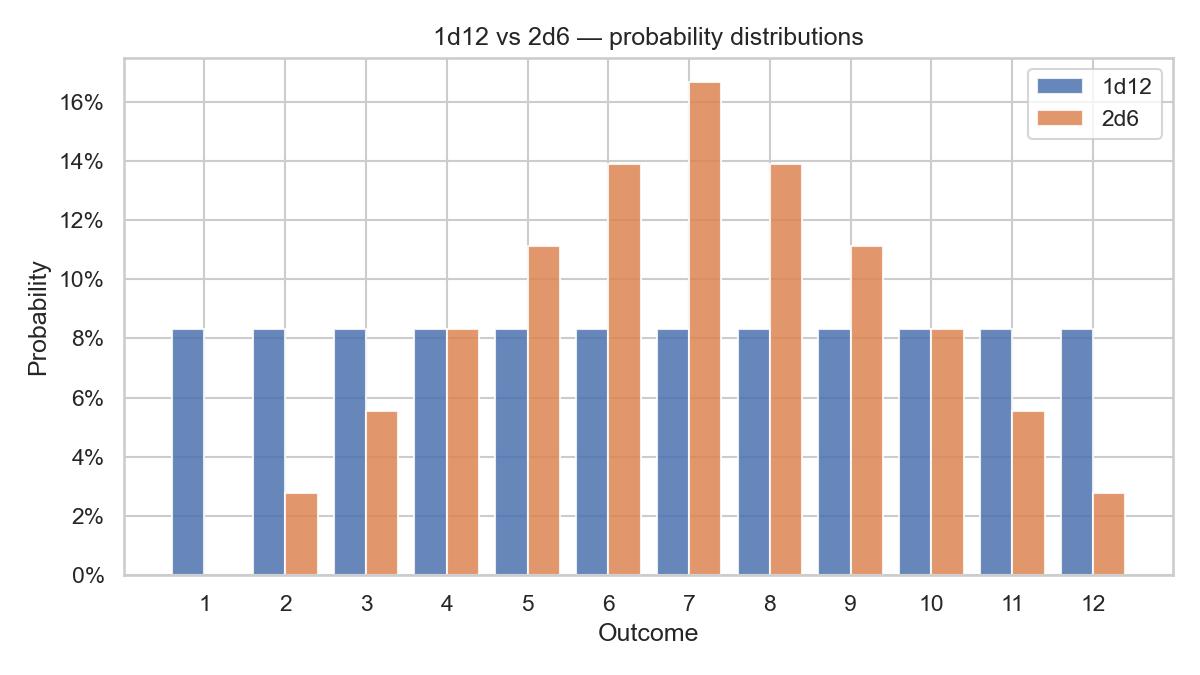
Something interesting is seeing how the distribution changes based on the constituent dice we use. A D12 has a different distribution to 2D6, as we’ve seen. But what if we compare that to 3D4? They both have a maximum of 12. From the Central Limit Theorem, we know that the more dice we roll, the more normally distributed the outcome starts to look. So let’s work with a number with lots of factors (36), and compare a bunch of combinations to see how the distributions change.
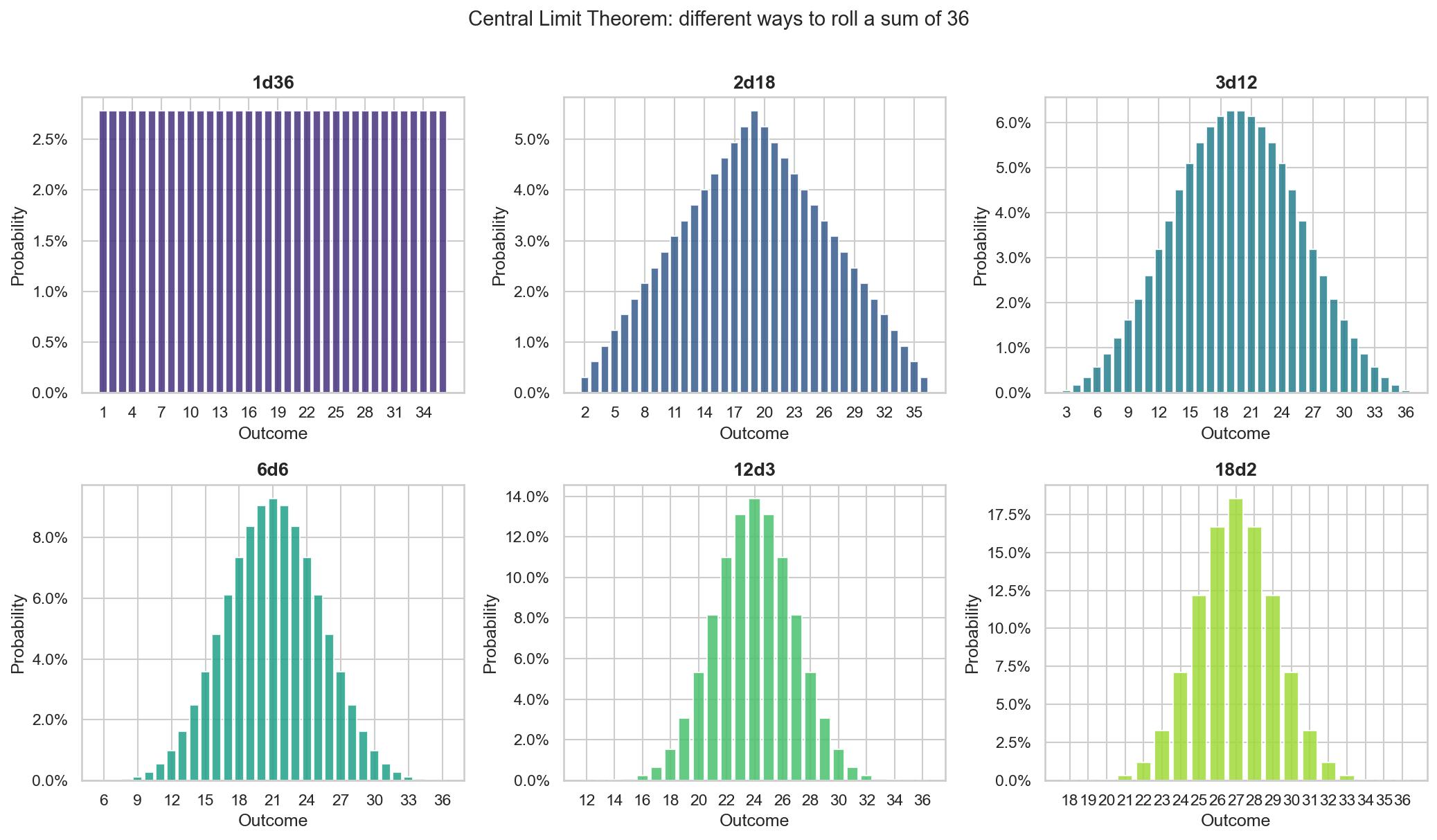
The normal distribution is a feature, not a bug. It makes games like Catan and Monopoly far more engaging. This doesn’t even cover how six-sided dice are cheaper to produce and way more accessible. If you lose a six-sided dice from a board game, it’s fairly likely you’ll have spares elsewhere. How many people own a D12?
D&D: skill checks vs damage rolls
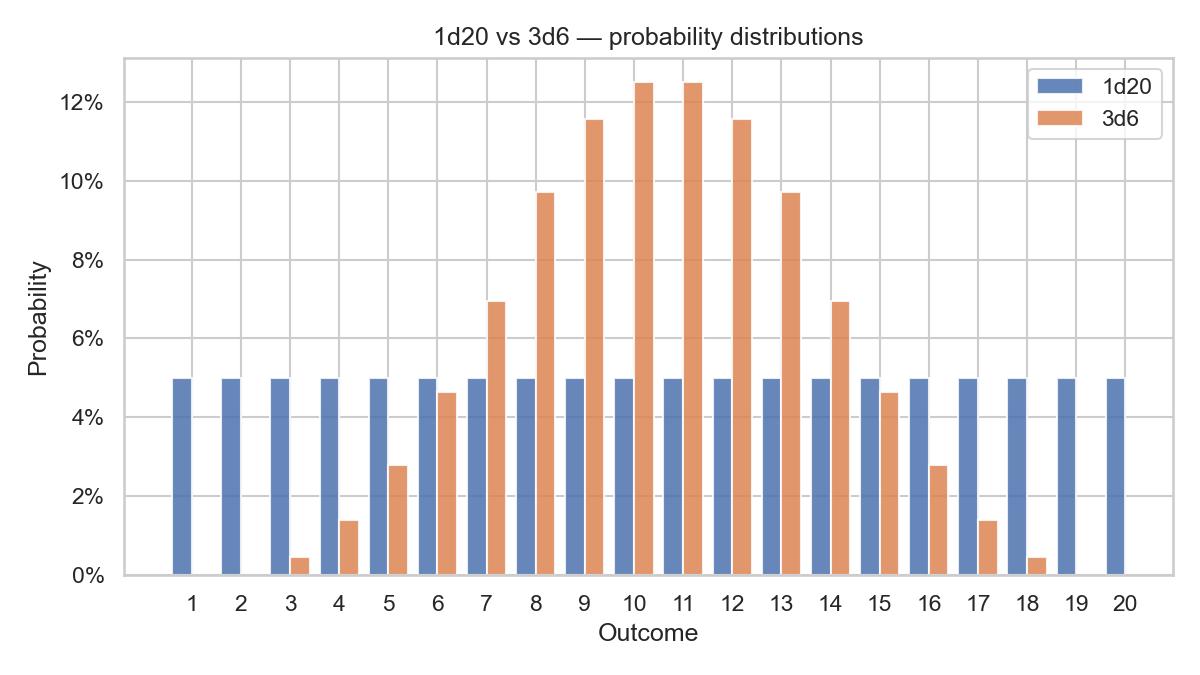
Dungeons & Dragons is also a fan of (occasionally) normally distributing outcomes. Most of the time, we use a D20. This is the backbone of most skill checks — the D20 has a uniform distribution of outcomes, which makes for easy maths. But for damage rolls, the designers preferred something like 3D6. These have similar ranges (1–20 vs 3–18), but hugely different distributions. The 3D6 follows a more normal distribution, and therefore a fireball doing max or min damage becomes an outlier, as opposed to a coin toss.
We can compare the distributions here:
Advantage and disadvantage
There are some other interesting things we can do with dice and their outcomes. There’s a mechanism in D&D called (dis)advantage, where you roll two dice and pick either the highest or the lowest outcome. This is interesting because the range of outcomes is conserved — you cannot exceed 20 or roll less than 1 — but the probability curve is shifted.
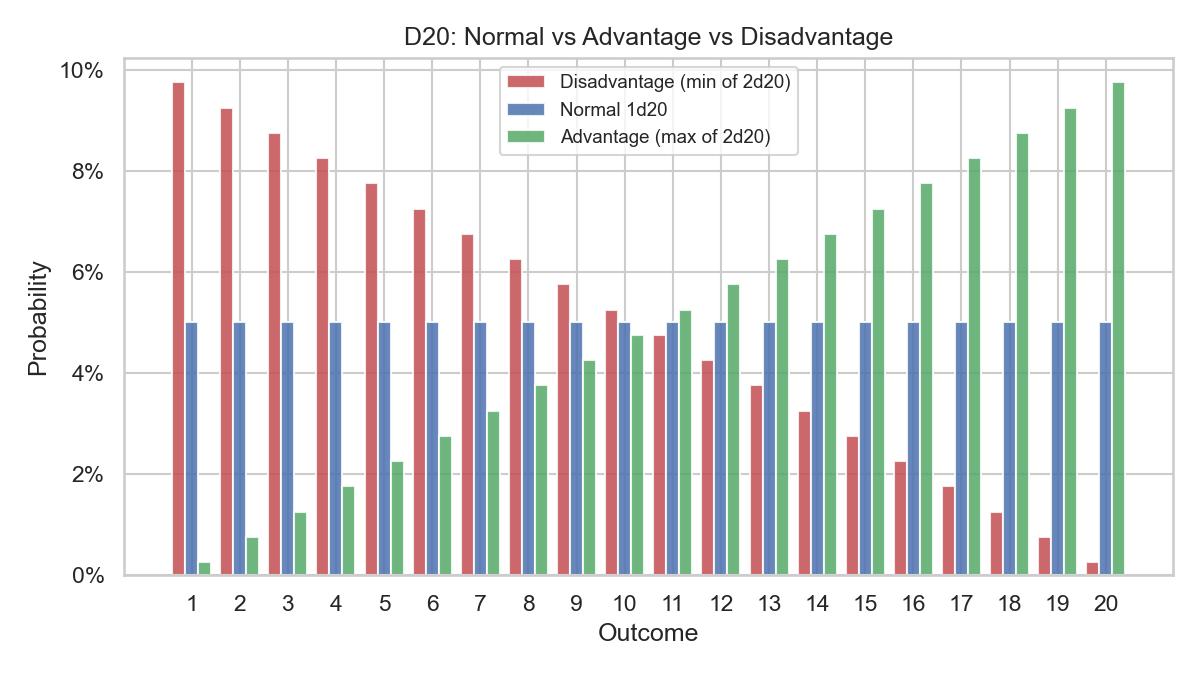
This makes advantage a powerful gameplay mechanic. If I’m doing a skill check but I’m being assisted somehow (have advantage), then I can’t break the game, but my odds of succeeding go up. And they can go up pretty quickly, as we see below when we keep stacking advantage:
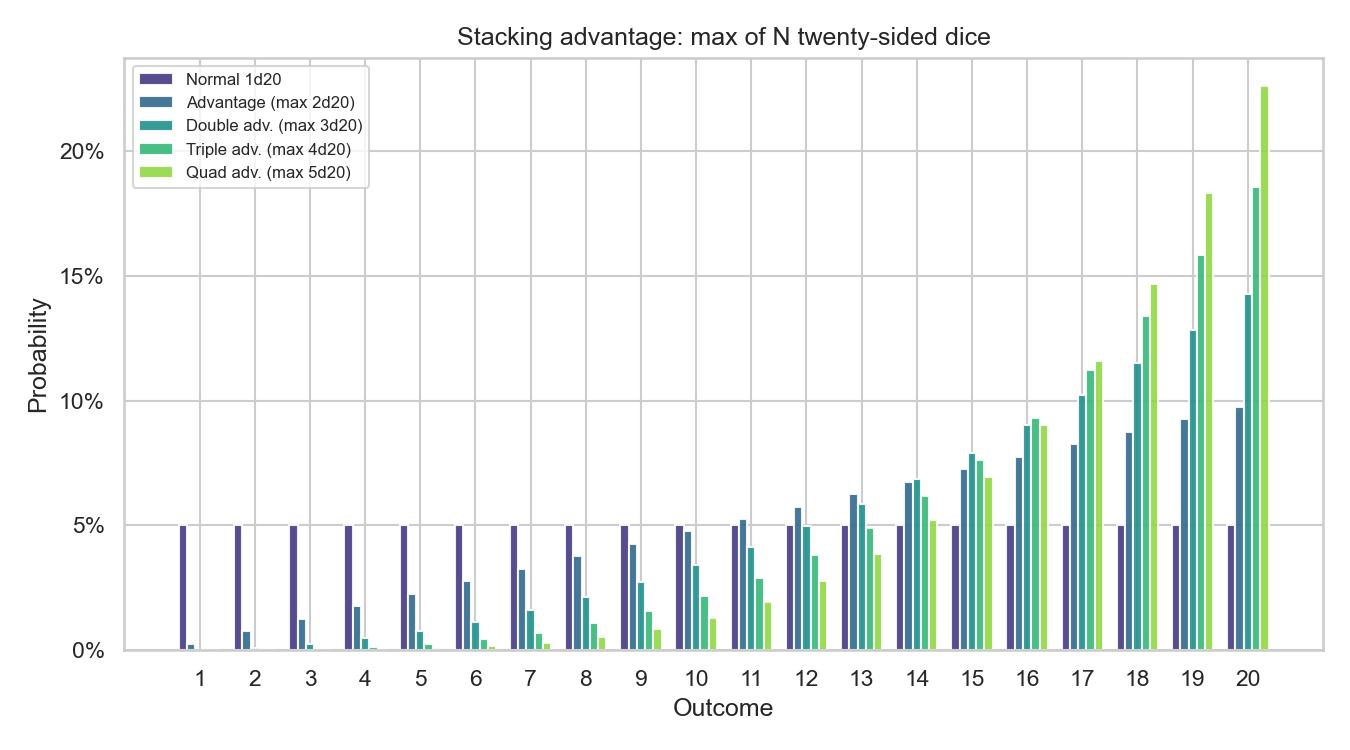
Advantage and disadvantage will never change the bounds of the outcome. This works well for skill checks, where the result is compared to a threshold with a binary outcome (succeed or fail). Providing the threshold is under 20, advantage works well as a mechanism. And we have modifiers for those instances where the threshold is over 20 — for example, a strength-based check could be a D20 + 5 (for a 5 STR modifier), and in this case the character could pass a DC 25 one-twentieth of the time. With advantage, it becomes one-tenth of the time.
Exploding dice
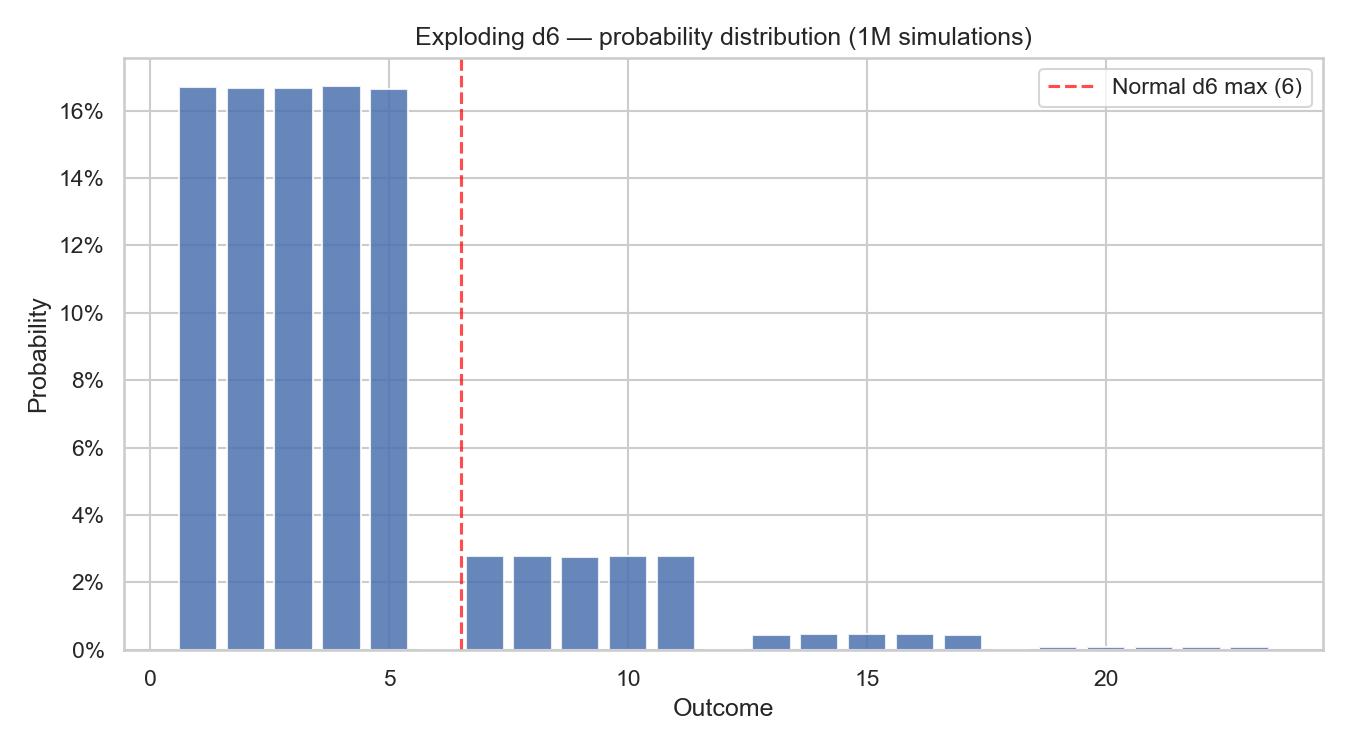
But what do we do for damage rolls, or instances where the outcome isn’t used to find a pass/fail? Some games have the concept of exploding dice. Here, if you roll the max outcome, you roll again and add that roll to the max. If that happens to be the max again, keep going. This can (in theory) lead to infinitely high outcomes.
For example, I have a D6 and I roll 6. I’ve hit the maximum, so I roll again. If my second roll is a 3, my total is 9 (6+3). If my second roll is a 6, I roll once more. Say my third roll is a 2. Then my total would be 14 (6+6+2). Exploding dice follow a more interesting distribution, which ends up looking a bit like a wonky power law.
Dice pools
A lot of the mechanics we’ve talked about so far have the gameplay outcome linked directly to the dice result.
In Monopoly, rolling a 5 moves you forward 5 spaces. In Catan, rolling a 7 activates the Robber. In D&D, rolling a 20 gives you a critical success, or a damage roll of 14 deals 14 points of damage.
But other types of games use a different mechanic altogether, called a dice pool. Warhammer is the best example here.
In dice pool mechanics, you roll a pool of dice (as the name suggests), and then the outcome corresponds to the number of dice which exceed a certain threshold. If we simplify, imagine I have five coins. I need to flip all of my coins, and to win a bet I need to get three heads. This is pretty easy maths so far. The number of coins I have is variable. A more powerful character might have ten coins — getting three heads for them is pretty trivial. A weak character may only have three coins, and therefore getting three heads is more of a challenge.
Now, if we go from coins to dice, imagine each coin is a D10. The pass/fail threshold is six. Rolling a 6 or higher is effectively a head. So if I need three heads with five coins, I roll five D10s, and three of those need to be at least 6.
There’s a real psychological pleasure to this, I feel, as we can directly feel our characters becoming more powerful based on the number of dice we get to roll. In D&D, modifiers represent power, but ultimately we’re still rolling a single D20. In a dice pool world, going from the start of the game to the end might lead to a huge increase in the number of dice we play with. The downside, of course, is that this is more time-intensive and a bit harder to track.
There are also other things we can do here — rolling a max value could count as two successes, rolling a 1 could cancel a success, and so on. The dice pool probability distribution looks something like this:
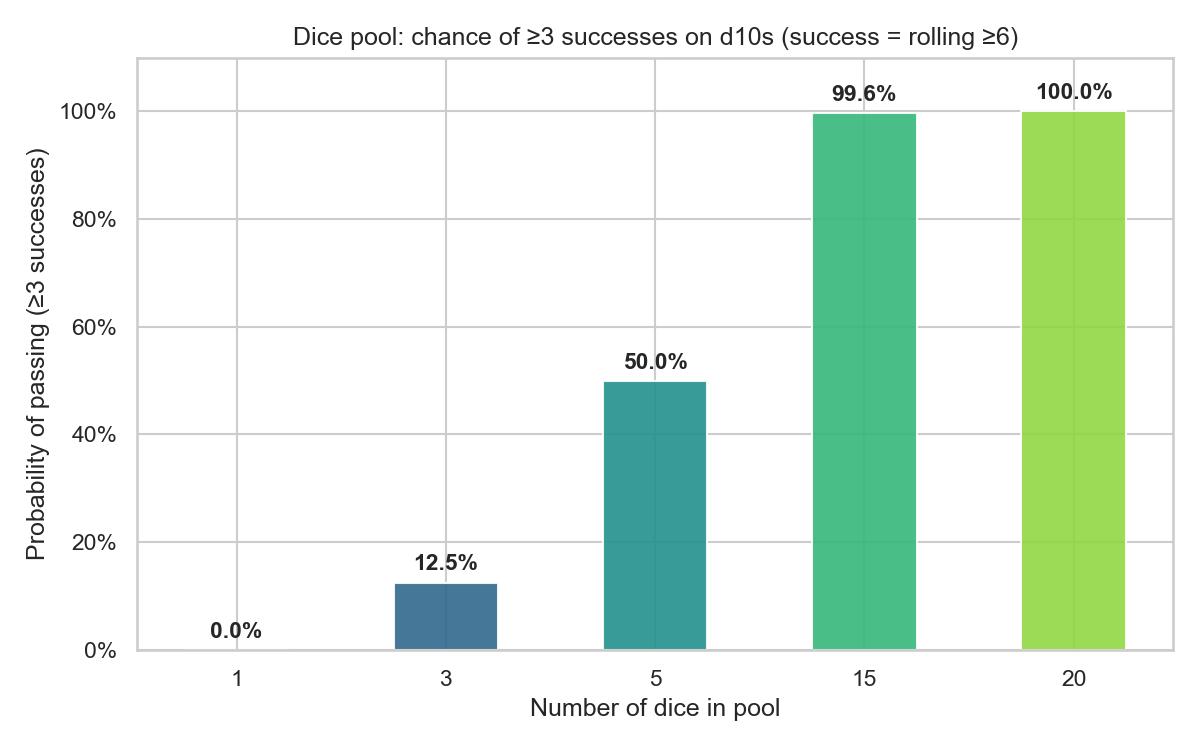
This is intuitively quite different to the D&D style. I don’t know what I prefer.
Wrapping up
What I find neat about all of this is that dice are really just a game designer’s toolkit for shaping randomness. A single fair dice gives you pure chaos — every outcome equally likely. Add more dice and you get a bell curve, making extremes rare and middles common. Advantage shifts the curve without breaking the bounds. Exploding dice blow the ceiling off entirely. And dice pools turn the question from “how much?” to “how many?” Each of these creates a fundamentally different feeling at the table, and the best game designers pick the right mechanic to match the experience they want players to have.
I’m not super familiar with dice pool mechanics, and while researching for this piece I came across some great work from someone called Meinberg, who blogs a lot about game design. His main blog is here, and I found this post on dice pools super helpful.